
August 18, 2026
No Rain, Record Heat, and a Wet Ceiling: AC Drain Leaks in August
By Chris Johnston, Founder, WaterDamageIQ
The short version
South Florida is in a dry, hot stretch: repeated heat advisories, Miami and Fort Lauderdale about a foot of rain below normal for the year, and near-record highs forecast for the Palm Beaches this week. Air conditioners are running nearly nonstop, and every hour they run they pull water out of the air and send it down a small condensate drain line. Algae and sediment build up in that line, and when it clogs, the pan overflows into the ceiling, the closet, or the floor. The EPA advises keeping AC drip pans clean and drain lines flowing. Check yours this week. A slow leak is also an insurance problem: many Florida policies exclude damage from leakage or condensation that goes on for weeks, so a stain you ignore can turn a covered loss into a denied one. If you find water, photograph it, shut the system off, dry the area within 24 to 48 hours, and report it.
A hot, dry August
August is usually wet in South Florida. Local 10 meteorologist John Gerard put it plainly on Saturday: “August is typically our third wettest month of the year,” but the drought would continue, with only about half an inch of rain expected over the next seven days.
The numbers behind that, all from the past week:
- Miami hit a 108 degree heat index on August 10 and 11, the highest recorded there so far this year, Local 10 reported. Another heat advisory was in effect on Saturday.
- Through August 13, Miami and Fort Lauderdale were about 12 inches of rain below normal for the year, FPREN reported, and about 90 percent of Florida was in some level of drought, with extreme drought across South Florida.
- WPTV forecast highs of 95 to 97 degrees for the Palm Beaches and Treasure Coast today, with possible daily records, and a feels-like temperature of 105 to 110 on Wednesday.
No rain sounds like a break from water damage. It is not. When the afternoon storms don't come to cool the house, the air conditioner runs nearly all day. And an air conditioner is a water machine.
How an AC drain line floods a ceiling
Your AC cools by pulling warm, humid air across a cold coil. Moisture condenses on the coil, drips into a pan, and leaves the house through a small pipe, the condensate drain line. In a South Florida summer that line carries water every hour the system runs.
Building scientist Allison Bailes writes that algae can grow in these lines, and that clogs are most likely in very hot weather, when the AC runs the most. When the line clogs, the water has nowhere to go. It fills the pan and spills.
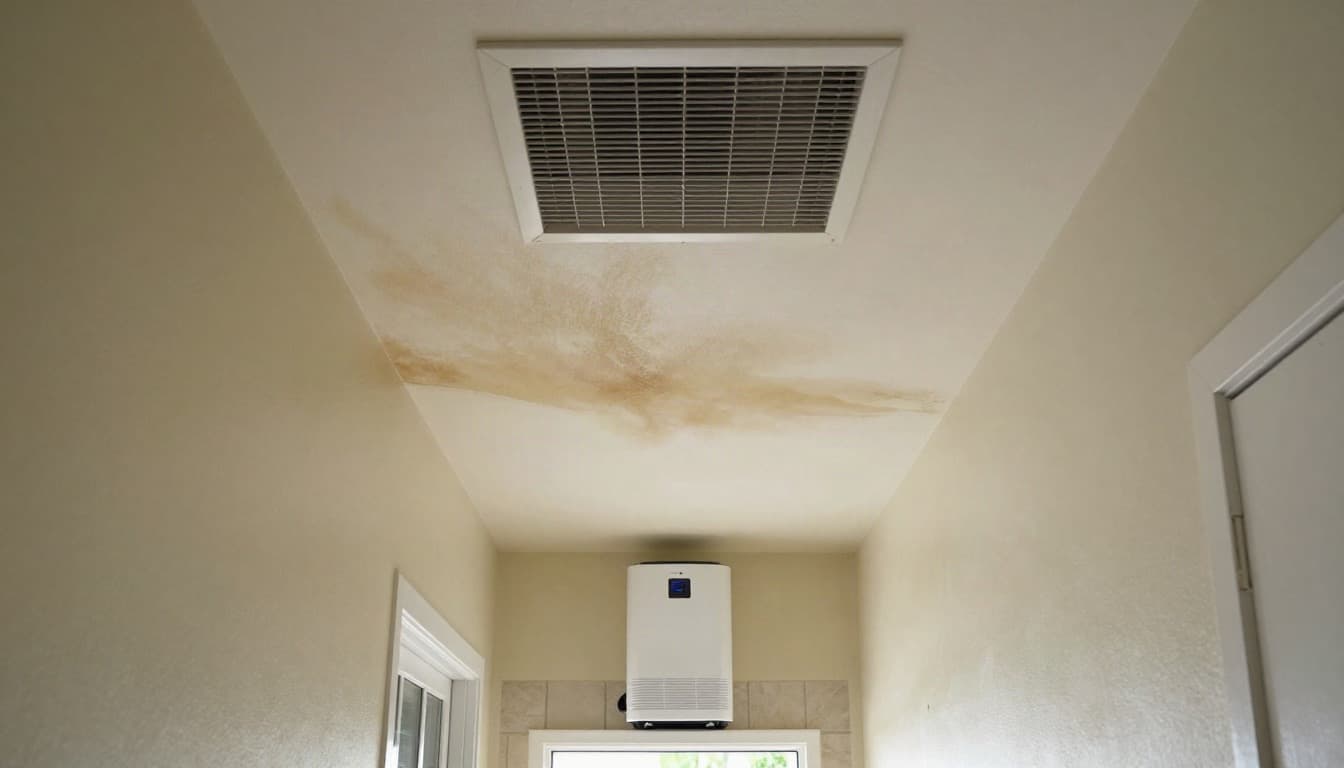
Where it spills depends on where the air handler sits. In a closet, it soaks the floor and the bottom of the walls. In an attic, it soaks the insulation and then the ceiling drywall below, which is how a lot of August ceiling stains start. In a condo, it can run into the unit below you.
Check it this week: five minutes
- Find the end of the line. Outside, usually near the condenser or foundation, a small PVC pipe. With the AC running on a hot day, it should drip steadily. Dry or barely trickling is a warning sign.
- Look at the air handler. Open the closet or attic access. Is there water in the pan underneath? Rust stains, a wet floor, damp insulation?
- Look up. Ceilings near the air handler and below any attic unit. Photograph any stain you find, with the date, so you can tell later whether it is growing.
- Smell. A musty closet or a musty first blast of air when the system starts can mean standing water somewhere.
- Ask about a shutoff. Many systems have a float switch that turns the AC off when the pan fills. Ask your HVAC tech whether yours does, and where. If your AC quits on a hot afternoon, a full pan is one of the first things to check.
The EPA's mold guidance says it simply: keep air conditioning drip pans clean and the drain lines unobstructed and flowing. For a clog, many people use a wet-dry vacuum sealed to the outside end of the line. Bailes recommends an algaecide made for air conditioners for prevention, and is blunt about the shortcut: “Don't use bleach! It can cause a host of problems.”
Why a slow leak is an insurance problem
A burst pipe is a sudden event. A drain line that has been dripping into the ceiling for a month is not, and many policies treat the two very differently.
- The 14-day clause. Many property policies exclude loss from constant or repeated seepage or leakage over 14 or more days. In Hicks v. American Integrity (2018), Florida's Fifth District Court of Appeal read that wording as not clearly excluding leakage over 13 days or less, and ruled for the homeowner on the first 13 days.
- The weeks-months-years clause. Citizens has used an exclusion that covers leakage and also “the presence or condensation of humidity, moisture or vapor” that occurs “over a period of weeks, months or years.” In Feldman v. Citizens (2023), the Fourth District sent that fight back for a new trial.
Our read, not legal advice: the wording in your own policy decides this, and the longer a leak runs after you could have noticed it, the harder the claim gets. That is the case for checking the drain line and the ceiling now, and reporting a leak the day you find it. Florida Statute 627.70132 allows one year from the date of loss to give notice, but a slow leak is a reason to move faster than that.
If you find water
- Turn the AC off at the thermostat so the pan stops filling. If water reached a light fixture or outlet, turn that circuit off at the panel.
- Photograph everything first. The stain, the pan, the wet floor, the dry drain outlet outside. Close and wide.
- Dry within 24 to 48 hours. That is the EPA's window to prevent mold. Pull wet insulation, run fans and a dehumidifier. The EPA advises keeping indoor humidity below 60 percent, ideally 30 to 50.
- Clear or fix the drain, or have an HVAC technician do it, and keep the invoice. It shows the cause and the date.
- Report it to your insurer, and in a condo to the association, in writing, with photos.
Not sure whether a stain is new, or how far the water went? Our free damage check reads your photos, separates what we can see from what might be hidden above the drywall, and gives you a timestamped report for your insurer or contractor. If you have not yet documented the rest of the house, our walkthrough checklist covers it.
Find help in Florida
Our Florida directory lists water mitigation crews, mold specialists, plumbers, and public adjusters, with licence numbers from public record where they exist.
HVAC tech in South Florida?
If you are clearing drain lines all week, I want to hear what you are seeing: how many calls, attic versus closet units, what owners miss. We publish guest field notes under your name. Email reports@waterdamageiq.com.
Common questions
Why does my AC leak more in August?
Because it runs more. An air conditioner removes moisture from the air, and that water drains through a condensate line. Building scientist Allison Bailes notes that algae can grow in these lines and that clogs are most likely during very hot weather, when the system runs the most. This August, with heat advisories and little rain to cool things off, many South Florida systems are barely cycling off.
What are the signs of a clogged AC drain line?
Water in the secondary pan under the air handler, a wet floor or carpet near the unit, a ceiling stain under an attic air handler, a musty smell, or little to no water dripping where the drain line ends outside. Some systems shut themselves off when the pan fills, so an AC that stops cooling on a hot afternoon can be a drain problem.
Can I clear the drain line myself?
Often. A common method is a wet-dry vacuum sealed tightly to the outside end of the line to pull the clog out. Bailes recommends an algaecide made for air conditioners for prevention and warns: "Don't use bleach! It can cause a host of problems." If the line keeps clogging, or water has reached drywall, call an HVAC technician.
Does homeowners insurance cover AC leak damage?
It depends on the policy and how long the leak went on. Many policies exclude repeated seepage or leakage over a set period. In Hicks v. American Integrity (2018), a Florida appeals court read a 14-day version as not clearly excluding the first 13 days. Citizens has used wording that also covers the presence or condensation of humidity, moisture or vapor over a period of weeks, months or years. Read your exclusions and report a leak as soon as you find it.
When does a wet ceiling turn into a mold problem?
The EPA says to dry water-damaged areas and items within 24 to 48 hours to prevent mold growth, and to keep indoor humidity below 60 percent, ideally 30 to 50 percent. If mold covers less than about 10 square feet, the EPA says most people can clean it themselves. Larger areas, or mold inside walls or ductwork, call for a professional.
How long do I have to report water damage in Florida?
Florida Statute 627.70132 requires notice of an initial or reopened property claim within one year after the date of loss. With slow leaks, waiting can also feed a seepage exclusion argument, so report once you find the damage.
Water already inside?
Upload a few photos. In minutes you get what repairs should cost, whether a claim clears your deductible, and a timestamped report you can hand to an adjuster. Free, no account.
Sources
- Local 10 News, Aug 11, 2026: A streak of heat advisories issued for South Florida this week
- WUFT / FPREN, Aug 14, 2026: Hot, storms bring flash flood threat for part of Florida while still having great rain deficits
- Local 10 News, Aug 15, 2026: Another heat advisory in effect in South Florida
- WPTV forecast, Aug 17, 2026: Intense heat pattern to bring near-record temperatures
- EPA: A Brief Guide to Mold, Moisture and Your Home
- Green Building Advisor (Allison Bailes), Jul 8, 2015: How to clean an air conditioner condensate drain
- Merlin Law Group, Mar 13, 2018: Water leak over 14 days or more (Hicks v. American Integrity)
- Clausen Miller, Sep 1, 2023: Fourth DCA orders new trial on constant and repeated seepage exclusion (Feldman v. Citizens)
- Florida Statutes 627.70132: Notice of property insurance claim
About the author
Chris Johnston. Chris Johnston founded WaterDamageIQ in Palm Beach Gardens, Florida, to give property owners a straight read on water damage before the first phone call to an insurer or contractor.
This is general information, not legal or insurance advice. Your policy language and your adjuster decide your claim.