
September 18, 2026
Rain After a Drought Year: Where Florida Homes Leak First
By Chris Johnston, Founder, WaterDamageIQ
The short version
South Florida spent much of 2026 in drought. This week the rain came back hard: on Thursday, September 17, a flood advisory covered Broward County, cars stalled on flooded roads, and county emergency managers said the ground was saturated. The National Weather Service still listed most of Palm Beach, Broward and metro Miami-Dade in moderate drought the same morning, and the wet season runs to October 15. Steady rain after a dry stretch is when roof, window and wall leaks show up. Check the attic and ceilings after each storm, dry anything wet within 24 to 48 hours, and report damage early: many Florida policies exclude water that leaked for 14 days or more, and Florida law gives you one year from the date of loss to give notice of a claim.
What happened this week
Thursday morning, September 17, a stalled front and deep moisture parked rain over metro Broward and Palm Beach. NBC 6 reported several inches of water on some Broward roads, stalled cars, and detours. A flood advisory covered Broward until noon.
Broward County's Office of Emergency Management put the cause plainly on X: “the grounds are saturated due to increased rainfall in many areas of Broward.” The National Weather Service in Miami told drivers: “Do not drive across flooded roadways and take extra time in reaching your destination this morning.”
The odd part is the backdrop. The Weather Service's drought statement issued the same day still listed most of Palm Beach, Broward and Collier counties, plus metro Miami-Dade, in moderate drought, with severe drought in the Everglades. It credited “daily scattered to numerous shower and thunderstorm activity” for the improvement. The wet season officially ends October 15, so there are four more weeks of this pattern on the calendar. NBC 6's forecast (a prediction, not a promise) called for 80 percent rain chances Friday through Sunday.
Why the first wet weeks find the leaks
This part is our read, not a news fact. A roof can carry a small defect for months without a drop coming through, as long as it barely rains. A cracked boot around a plumbing vent, a lifted shingle or tile, a gap where flashing meets a wall, a window frame with failed caulk. Then come several days of storms in a row, often with wind, and water finds the path. The ground is saturated, gutters overflow, and the house never gets a dry day to recover.
So the leak you notice this week may not be new damage. It may be an old weak spot that finally got tested. That matters for repairs, and it matters for insurance.
Where to look after each storm
- The attic. Take a flashlight up after a heavy rain, if you can do it safely. Look for wet or matted insulation, dark stains on the roof deck, and drips around vents, skylights and the chimney chase.
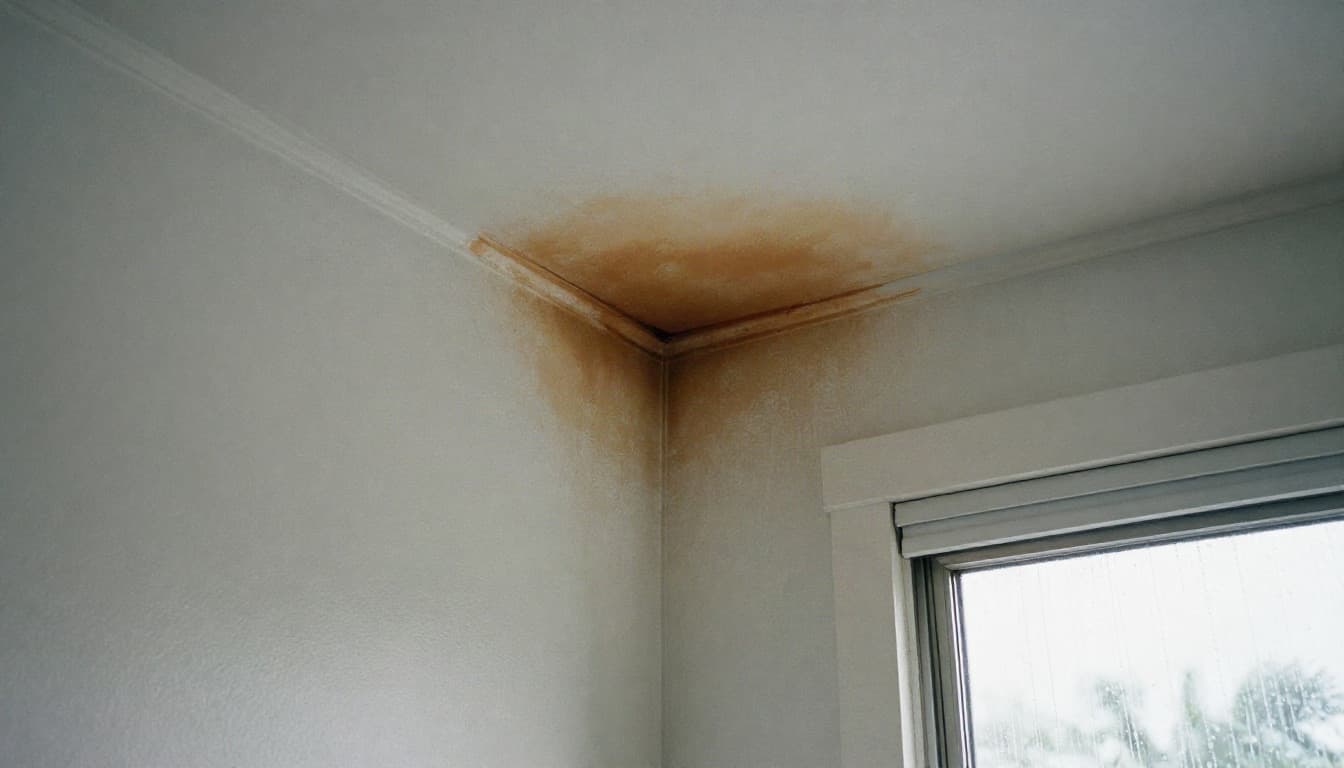
- Ceilings. A new ring, bubbling paint, or a soft sagging patch. Check around light fixtures and bath fans, where water often shows first.
- Tops of exterior walls and window frames. Stains in the corners, swollen trim, paint lifting at the sill. Wind-driven rain gets in sideways.
- Sliding doors and the floor beside them. Wet carpet tack strip or a cupped board near a slider usually means water is getting past the track.
- Outside. Gutters and downspouts. The EPA lists cleaning and repairing gutters as a basic moisture control step. Water that spills over the gutter lands against the wall and the slab.
Take a dated photo of every stain the first time you see it, then again after the next storm. A stain that grows is an active leak. That photo trail is also your best evidence later.
The 14-day clause most Florida owners never read
Many Florida homeowners policies carry a version of this exclusion, quoted here from a 2018 law firm summary: “We do not insure for losses caused by constant or repeated seepage or leakage of water over a period of 14 or more days.”
In Hicks v. American Integrity, Florida's Fifth District Court of Appeal held that the “14 days or more” wording does not clearly exclude damage from the first 13 days, and that the insurer has to prove which damage happened after day 13. Policy forms change, and yours may be worded differently. The practical lesson does not change: a leak you find and report this week is a much simpler claim than one you report in November.
If you need roof work
Florida Statute 553.844(5) sets a rule worth knowing before anyone quotes you a full replacement. If your roof or roof section was built, repaired or replaced to the 2007 Florida Building Code or later, and 25 percent or more of it is being repaired or replaced, only the repaired portion has to meet the current code. Older roofs may fall under different rules. Ask the roofer which applies, in writing.
Get the roof dried in first. A tarp over an active leak protects the inside of the house and shows your insurer you acted to limit the damage. Keep the receipt.
Dry it within two days
The EPA says to dry water-damaged areas and items within 24 to 48 hours to prevent mold growth, and to keep indoor humidity below 60 percent. If a moldy area is larger than about 10 square feet, the EPA points you to professional remediation guidance rather than a weekend cleanup.
Wet insulation and drywall hold water out of sight. A ceiling can feel dry and still be wet on the back side. If you are not sure how far the water went, that is the question to answer before you paint over a stain.
Not sure what you are looking at?
Our free damage check reads your photos of the stain, the attic, or the wall, separates what we can see from what might be hidden, gives a repair cost range, and tells you who to call. You get a timestamped report, which also helps if the 14-day question ever comes up.
When you need hands on site, our Florida directory lists roofers, water mitigation crews, mold specialists and public adjusters, with licence numbers from public record where they exist.
The clock
Florida Statute 627.70132 gives you one year after the date of loss to give your insurer notice of a property claim, and 18 months for a supplemental claim. With a slow leak, the date of loss can be argued. Do not give anyone room to argue. Photograph it, write down the date you found it, and report it.
Common questions
Why do roof leaks show up after a long dry spell?
A small gap in flashing, a cracked seal around a vent, or a lifted shingle can sit unnoticed for months when it barely rains. Day after day of storms, often with wind, is what finally pushes water through. The first wet weeks of a season are when those weak spots get tested.
What are the first signs of a roof leak inside the house?
Look for a new yellow or brown ring on the ceiling, paint that bubbles or peels, a sagging spot in drywall, damp insulation or dark wood in the attic, and a musty smell in one room. Check around ceiling lights, exhaust fans, and the tops of exterior walls and window frames. A stain that grows after each storm is an active leak.
Will my insurance cover a leak I did not notice for weeks?
It may not cover all of it. A common Florida exclusion reads: we do not insure losses caused by constant or repeated seepage or leakage of water over a period of 14 or more days. In Hicks v. American Integrity, Florida's Fifth District Court of Appeal held that this wording does not clearly exclude damage from the first 13 days, and put the burden on the insurer to show which damage came later. Your policy wording controls, so report damage as soon as you find it.
Do I have to replace my whole roof if part of it is damaged?
Not always. Florida Statute 553.844(5) says that if a roof or roof section was built, repaired or replaced to the 2007 Florida Building Code or later, and 25 percent or more of it is being repaired or replaced, only the repaired portion has to meet the current code. Older roofs can be treated differently, so ask your roofer and your insurer which rule applies to yours.
How fast do I need to dry a wet ceiling or wall?
The EPA says to dry water-damaged areas and items within 24 to 48 hours to prevent mold growth, and to keep indoor humidity below 60 percent. Wet insulation and drywall hold water out of sight, so a ceiling that feels dry on the surface can still be wet above.
How long do I have to file a claim for a roof leak in Florida?
Florida Statute 627.70132 requires notice of an initial or reopened property claim within one year after the date of loss, and a supplemental claim within 18 months. Report sooner. Early photos and early notice make the claim easier to prove, and they help with the 14-day seepage question.
Water already inside?
Upload a few photos. In minutes you get what repairs should cost, whether a claim clears your deductible, and a timestamped report you can hand to an adjuster. Free, no account.
Sources
- NBC 6 South Florida, Sep 17, 2026: Flood advisory in effect in Broward as storms drench roadways
- NWS Miami, Sep 17, 2026: Drought Information Statement for South Florida
- Rumberger Kirk, May 3, 2018: Fifth DCA strikes blow to popular policy exclusion (Hicks v. American Integrity)
- Florida Statutes 553.844: Windstorm loss mitigation, roofing (subsection 5)
- EPA: A brief guide to mold, moisture and your home
- Florida Statutes 627.70132: Notice of property insurance claim
About the author
Chris Johnston. Chris Johnston founded WaterDamageIQ in Palm Beach Gardens, Florida, to give property owners a straight read on water damage before the first phone call to an insurer or contractor.
This is general information, not legal or insurance advice. Your policy language and your adjuster decide your claim.